How do you ride 333.54 miles in 12 hours? Six months after shoulder surgery, Jake Sargent returned to the National 12-Hour Time Trial with a simple plan: start hard and hold on. At an average of 27.8 mph, he went on to set a new competition record. Here, he shares the training, preparation, fuelling, equipment and mental strategy behind the ride.
27.8 mph for 12 Hours: Inside a Record-Breaking TT
From Shoulder Surgery to the Start Line
Coming into 2026, the goal for Jake Sargent and his coach Matt was simple. It wasn’t to win or break any records; it was to get back in the swing of things after shoulder surgery at the beginning of the year.
Jake had been plagued with an unstable shoulder ever since a crash in 2021, regularly dislocating it while trying to get into his skinsuit and even racing key events having just relocated it. It was only when he sneezed while driving and his shoulder popped out that he decided it was finally time to do something about it.
He underwent surgery on 31st December and was immediately sidelined for three weeks, completely off the bike. Having never had so long away from cycling, even the thought of losing his 430-week Strava streak was terrifying.
Matt remained confident that Jake would be fine. The months before surgery had been spent building a strong base of fitness, making the most of the Christmas holiday to really ramp things up and get the hours in.
The surgery went well and Jake spent the next two months in a sling. He was allowed to return to turbo training after three weeks, once the stitches were out. Despite absolutely hating riding the turbo, it provided a way to maintain his fitness while his shoulder recovered, with Matt ensuring the training plan remained manageable.
The weeks passed quickly. By March, his physio had given him the all-clear to ride outside again.
From there, it was business as usual: daily commutes to work, alongside long rides and races at the weekend.
Building the Endurance
Jake doesn’t train on his TT bike as much as he would like. Most of his training takes place on his commute, riding through towns with a bag on his back, making the TT bike impractical for much of his daily riding.
But the commute is by no means bad news for his training.
He loves his rides to and from work and believes they are a key part of his success in longer events. A typical day might involve an hour of Zone 2 in the morning, followed by the key training session on the way home, already fatigued after a day on his feet and the morning’s ride.
He has followed this routine daily for the last six years and believes that consistency gives him an edge when racing over longer distances.
With this in mind, he and Matt planned to use the longer TT events on the calendar as preparation for the 12-hour, alongside a number of key TT bike sessions at weekends when time allowed.
In the build-up to the event, Jake raced four 50-mile TTs, including one after work, and two 100-mile TTs.
The final 100-mile event produced a PB, taking more than three minutes off his previous best. Combined with a power PB, it gave him the confidence that he was ready for the 12-hour.
Knowing Every Inch of the Course
Everyone who knows Jake knows how much he loves the 12-hour time trial, and this year’s event only reinforced that.
He had been looking forward to the race for months. When he discovered that the Nationals would be held on Welsh roads he knew so well, he believed there was an opportunity to do something special.
It was a course on which he had already dreamed of achieving something significant, ever since covering 317 miles on his first attempt back in 2024.
Preparation was meticulous.
Jake raced 25, 50 and 100 miles on the course in the months leading up to the event, learning every section and working out exactly where he could put each watt.
The race plan was simple:
Start hard and hold on.
12 Hours at 27.8 mph
Jake knew that any drop in power later in the race would be offset by the course becoming faster as the temperature and traffic increased.
Making it through the 90-mile morning circuit above 27 mph gave him immense hope as the race moved onto the much quicker afternoon circuit.
For the next 5.5 hours, he lapped at 28.5 mph, increasing his average speed to 27.9 mph while keeping his average power above 250 W.
It wasn’t all plain sailing.
Like many ultra-endurance events, the 12-hour comes with significant mental highs and lows. For Jake, hours seven to eight are usually the hardest, as the event transitions from a long day on the bike into something much more demanding.
Those low points were regularly remedied by seeing friendly faces on the side of the road cheering him on.
After nine hours, he moved onto the finishing circuit. At only 15 miles, it meant he would see his support crew approximately every 30 minutes.
The shorter circuits helped the time pass more quickly, while knowing he could access as much food and water as required gave him the confidence to push harder during the final hours.
He knew he was on the home straight.
The Mental Game
The 12-hour time trial is as much a mental game as a physical one, and keeping the mind occupied is an important part of getting through the final hours.
For Jake, one of the biggest distractions is what he calls his “internal radio”.
After a few hours, it switches itself on and continues playing until the end. He never knows what tracks will appear, and this year, unexpectedly, it was Christmas songs.
Another way of breaking up the long hours is knowing where familiar faces will be on the course and counting down the miles until he passes them.
An hour-long circuit can be broken down into smaller sections simply by waving to marshals, friends and supporters.
Then there is the maths.
In the final few hours, when the average speed is largely established, Jake starts calculating what distance might be possible. The calculations may not always be perfect, but eventually he reached 320 miles with half an hour still remaining.
He worked out that he only needed to average 10 mph to break the record.
That was all the motivation he needed.
He charged down the dual carriageway at 30 mph, sprinted up the hills and made every second count.
Twelve hours came and he passed the final timekeepers still on the course before bringing the bike to a stop 12 hours and five minutes after starting.
333.54 miles covered.
A new competition record.
Fuelling the Ride
The fuelling strategy was simple because it was already proven.
Jake took on 100 g of carbohydrate per hour from OTE Super Gel, alongside 500 ml of water with electrolytes.
He has a particularly durable stomach and can tolerate a significant carbohydrate intake over a 12-hour period, making full use of that capacity during the event. Carefully timed caffeine gels were added throughout the day to provide a boost as fatigue began to set in.
The key was familiarity. Nothing was being tested for the first time on race day.
Comfort Over 12 Hours
Remaining comfortable is one of the biggest challenges in a 12-hour time trial.
A small niggle or doubt can play on the mind all day, and losing focus can ultimately cost a rider the race.
Jake does all of his training in Nopinz Hypersonic jersey and bib shorts and has completed numerous six-plus-hour training sessions in them.
That meant race day came with complete confidence that the kit would remain comfortable for the duration.
His Hypersonic MK2 overshoes stayed perfectly in place throughout the event, while the SpeedPockets kept his arm numbers neatly secured rather than flapping in the wind and potentially costing valuable watts.
Comfort and Aerodynamics
Comfort wasn’t the only consideration.
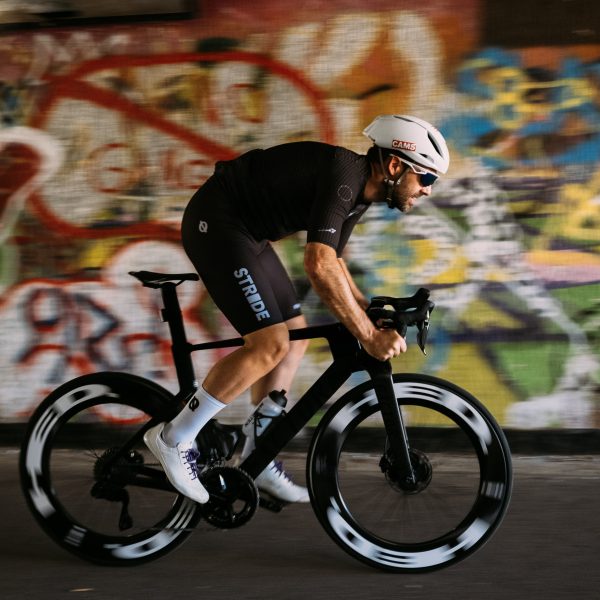
Rather than making last-minute changes to his position for the 12-hour, Jake had already visited Drag2Zero in the wind tunnel at the beginning of the year to test kit and position adjustments ahead of the 2026 season.
The changes were made with both the 12-hour and long-duration comfort in mind.
The result was a setup that remained just as comfortable, but was substantially quicker.
For an event lasting 12 hours, that balance is critical. Aerodynamic gains are only useful if the rider can maintain the position for the duration of the event.
Six Months From Surgery to a Record
Perhaps the most remarkable part of the performance was how far removed it was from where the year had started.
Riding with one arm in a sling back in February felt like a million miles from where Jake and Matt needed to be. There were genuine questions over how the shoulder would tolerate the TT position, and plenty of work still to do.
Matt guided Jake through the highs and lows of the comeback and helped him produce his best-ever physiological performance in just over six months.
The result was a ride that turned an initial goal of simply returning to racing into something far greater:
333.54 miles in 12 hours.
27.8 mph average speed.
A new competition record.
Thanks to everyone who played a part in the success, and a special thanks to Jake’s crew and everyone who came out to support him.