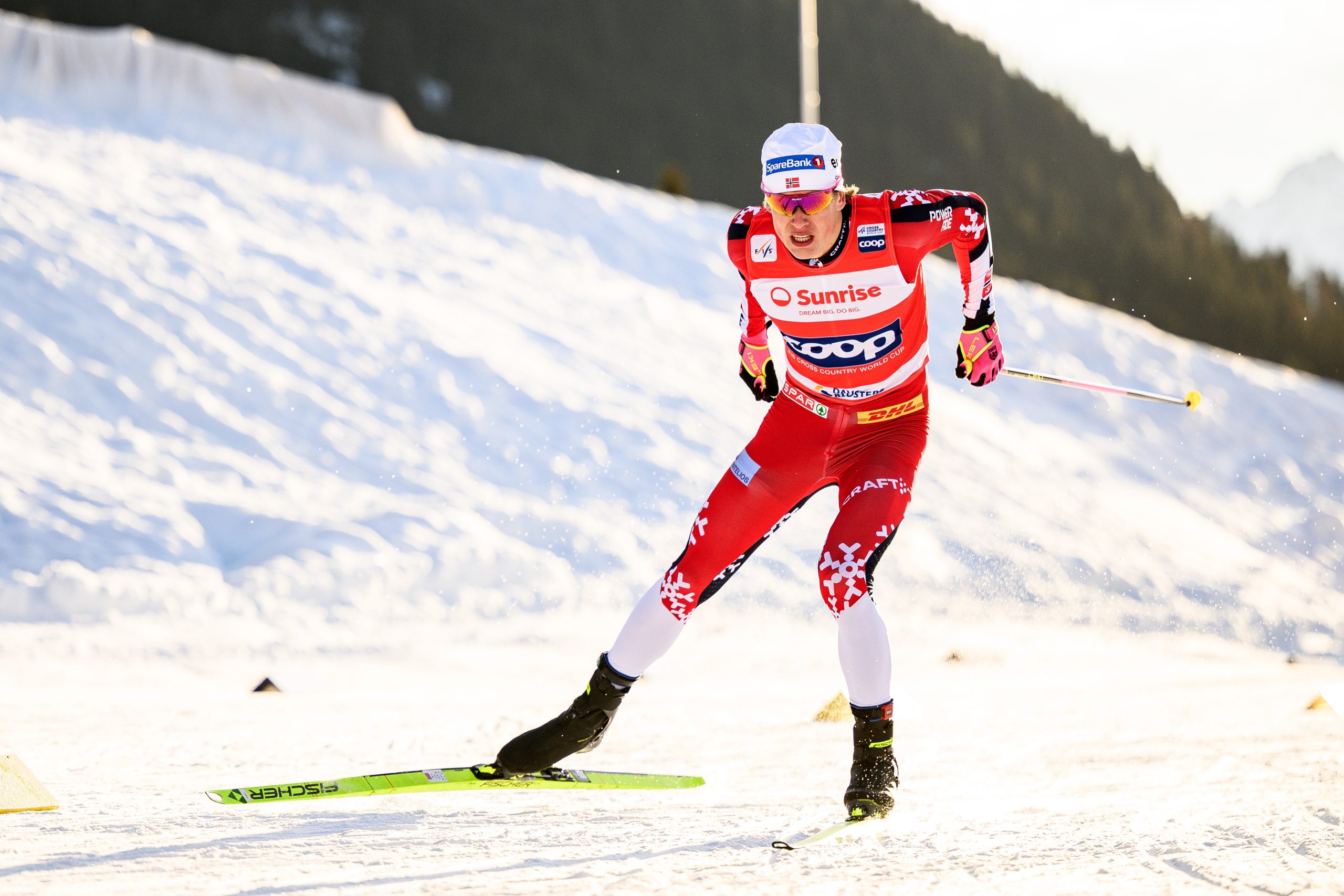
Johannes Klæbo spends 88% of his training in Zone 1, 12% in Zone 3 and almost no time in Zone 2. It’s an extreme approach from one of endurance sport’s biggest stars. As we head into winter, could the Klæbo method transform your cycling performance?
Train Easy, Race Hard: The Klæbo Method
Written by James Witts, content writer for Nopinz.
Johannes Høsflot Klæbo is arguably the greatest athlete you’ve never heard of. The 29-year-old Norwegian is a cross-country skier who has an incredible 11 Olympic gold medals to his name. That’s the most by any Winter Olympic athlete. Six of those came at the 2026 Olympics in Italy, setting another record for the most gold medals won at a single Games. Klæbo’s achievements are even more incredible when you look at the breadth of his talent, from a hard 20 minutes in the 10km freestyle to over two hours of heavy, sustained endurance in the 50km classical.
Cross-country skiing is one of the most physically demanding sports around with heart and lungs under severe stress to fuel both the upper body and lower limbs. That means huge aerobic capacities that regularly tip over 90ml/kg/min. In theory, you’d think such an extreme physiology would demand extreme training. And you’d be right. But not in the direction you’re thinking. You see, in a recent podcast with Rich Roll, Klæbo reveals that the secret to his extraordinary success heavily comes down to easy training. Interest piqued? It should be, as Klæbo’s training model is applicable to most amateur cyclists, too.
Goodbye middle ground
Klæbo knows how to suffer – all winners do – but for the bulk of his training programme, he skis at such an intensity that he could nose breathe his way through the session. That’s because Klæbo follows a training model where he spends 88% of his time in zone 1 (low-intensity aerobic work; less than 75% of functional threshold power) and completely avoids standard zone 2 ‘middle ground’ training (76-105% FTP). These are long, conversational sessions, like a three-hour ski in the morning followed by a two-hour ski in the afternoon.
He spends the remaining 12% at zone 3 (106%-plus FTP), such as his infamous ‘sprint ladder’ that involves sprinting up steep inclines with resistance bands. That means over his 32-hour training weeks, only around 2.5 to 3 hours are at high intensity. The rest – 29 to 29.5hrs – is easy. But why? It’s all down to his proven polarised model.
You might have heard of polarised training, otherwise known as 80/20 training, or may even already follow a polarised split. But for the unfamiliar, it follows a similar template to Klæbo but a slightly less extreme split of 80% at easy intensity and 20% high intensity.
(This is a prudent opportunity to briefly unpick the at-times complicated world of training by zones. There are many models available but two of the most popular are the three-zone model used by Klæbo and a five-zone model. Ostensibly, the five-zone model is a condensed version of the three-zone model.
(For the three-zone model, zone 1 covers easy endurance work; zone 2 spans moderate to threshold intensity; and zone 3 includes hard efforts above the upper threshold. The five-zone model adds detail, typically separating endurance, tempo, threshold, VO2max and anaerobic efforts. Thus, five zones allow more precise workout prescription and intensity control, while three zones simplify training-load analysis and highlight the balance between easy, moderate and hard training.)
The polarised training model stemmed from research undertaken by one of the world’s foremost exercise physiologists, Dr Stephen Seiler of the University of Agder, Norway. The American waded through years of analysis of elite endurance athletes’ training plans and concluded that the 80/20 split was optimum to deliver peak endurance performance. This endurance epiphany featured in his groundbreaking 2009 paper, ‘Intervals, Thresholds and Slow Distance: The Role of Intensity and Endurance Training.’
Benefits to amateur athletes
Since then, many researchers have built on Seiler’s work including Iker Muñoz Perez, of the University of Deusto in Bilbao, Spain, who co-authored a paper with Seiler in 2014, entitled, ‘Does polarised training improve performance in recreational runners?’ Which makes him the expert of experts to answer that very question: what are the benefits to Nopinz’ band of amateur cyclists by following an 80/20 split?
“Although polarised training is associated with elite athletes, almost all intervention studies in the scientific literature have been conducted on recreational athletes (of varying performance levels),” he tells us from his Basque home. “So, yes, it’s entirely feasible to apply this training rationale to recreational athletes.”
There it is. You have the green light to sit back during most of your rides and absorb the scenery… Maybe. Or maybe not depending on your cycling profile.
“The key factor lies in an amateur athlete’s overall training volume and training history,” adds Perez. “For instance, an athlete who can only train three hours per week across four sessions, spending just 40 minutes per session in zone 1, will receive an insufficient stimulus to maximise low-intensity adaptations. In such cases, opting for a traditional or threshold-focused model might be more effective.”
“However, when working with recreational athletes, regardless of their absolute performance level, who have years of training experience behind them and their training time exceeds six hours per week, we have a solid baseline to start implementing a polarised model.”
Physiology behind the split
So, the implementation of polarised requires a minimum amount of hours’ cycling each week. But why exactly? What are the benefits from this chasmic split between efforts?
“There are two key aspects to this,” explains Perez. “The first is that a high volume of low-intensity training (zone 1 in a three-zone model; zones one to two in a five-zone model) – that is, below the first physiological threshold – boosts stroke volume [the amount of blood pumped out of your heart with each beat] and oxidative phosphorylation by increasing mitochondrial biogenesis. This is a critical factor if high performance at higher intensities is also desired.”
Mitochondria are the cells’ energy powerhouses. By boosting their number and efficiency, you improve your ability to generate aerobic energy using oxygen, increase fat oxidation and reduce reliance on anaerobic metabolism. In performance terms, this means cycling for longer at a higher pace without bonking.
There’s also evidence that prolonged low-intensity training increases the release of cell-signalling compound interleukin-6 (IL-6), which contributes to fatigue. Well-trained athletes produce less IL-6 and are therefore more fatigue resistant.
Conversely, low-intensity work doesn’t generate the fatigue that shadows you from constantly hitting the middle zone, allowing the athlete to approach harder days fresh and ready to exercise at the required intensity. “This is one of the key principles of polarised training distribution,” says Perez. “Keeping easy days truly easy, without leaving residual fatigue that hinders achieving the required intensity and duration on demanding days.”
That means come those demanding days – the 20% – you can dig deeper to eke out greater top-end gains. On a physiological level, that means powering up type II muscle fibres, greater tolerance to metabolic acidosis, and an enhanced capacity for lactate clearance and its utilisation as an energy substrate. At a performance level, that means you can cycle faster, recover faster and cycle faster again, like you would on a climb of various gradients.
A polarised training week
That’s the theory. But what about the practice? For Perez, a typical polarised microcycle for a recreational cyclist training around 10 hours per week could be structured as follows, based on a five-zone model:
- Monday: 35mins in zone 1 + 20mins in zone 2 + 20mins in zone 3 + 15min in zone 1.
- Tuesday: 100mins in zone 1.
- Wednesday: Rest day.
- Thursday: 30mins in zone 1 + 5mins in zone 2 + 2 x (8 x 1min MAP with 30secs recovery in Zone 1) with 5mins between sets + 15mins in zone 1. Note: MAP stands for Maximum Aerobic Power, which is roughly the highest wattage you can hold for 5mins.
- Friday: 60mins in zone 1 – rest day.
- Saturday: 110mins in zone 1 + 70mins in zone 2 + 15min in zone 1.
- Sunday: 45mins in zone 1 + 2 x (10 x 30s at 105-110% MAP with 45secs recovery) with 5mins between sets + 20mins in zone 1.
Perez adds that depending on the athlete’s experience level, the time spent in zone 2 could be adjusted upward. “If the athlete can maintain a stable heart rate within this zone without crossing into zone 3 (in a five-zone model) – thereby avoiding cardiovascular drift – increasing volume in zone 2 could be a valuable strategy to promote further physiological adaptations.”
Do this and, according to a 2014 study by researchers Thomas Stoggl and Billy Sperlich, you’ll enjoy greater gains over other training models. They took eight well-trained endurance athletes who were randomly assigned to polarised, threshold, high-intensity or high-volume training groups and followed respective plans for nine weeks. Their intensity distribution comprised…
- Polarised: 68% easy, 6% threshold, 26% very hard
- High-intensity training: 43% easy, 57% hard
- Threshold: 74% easy, 26% threshold
- High-volume: 90% easy, 10% threshold
The polarised group had the largest improvements in several measures, including VO2 peak (+11.7%), time to exhaustion (+17.4%) and peak power (+5.1%).
You’ll notice that the polarised split wasn’t as cleancut as Perez’s model, drifting more toward 70/30. That’s because the researchers took into account the reality of training, namely keeping stoically to set zones isn’t always easy or natural.
“Terrain also has a big impact on sticking to specific zones,” says experienced cycling coach Mark Walker, who runs Mark Walker Coaching. “If you live somewhere hilly, heart rate creeps up by default.”
Parking the ego isn’t always easy during low-intensity sessions, either, with limited training time meaning you want to feel that you’ve worked out. It’s why Perez suggests amateur riders could train by heart rate rather than power on the easy days, as it’s a clear measure of the body’s internal strain rather than the fixed output, so reflects how an athlete is feeling on any given day.
Group riding is another stumbling block, as the intensity of group rides is dictated by the collective not the individual. But, adds Walker, if the social side of cycling is what you ride for, stick with the group. At the end of the day, cycling has to be about fun. But if you’re particularly goal oriented, you may need to train with slower riders or accept a trade-off between social riding and hitting intensity targets.
Conversely, the controlled nature of indoor training is a polarised practitioner’s dream, especially for the shorter high-intensity sessions. “Indoor trainers can also be very useful for controlling low-intensity rides, too,” say Walker. “But very long rides can be tough. Discomfort, monotony, heat and dehydration can all take a toll.” All of which can be eased, of course, by Nopinz’s range of indoor-cycling apparel. Find out more here.
Zones and intensity
Against the backdrop that adhering strictly to an 80/20 split is near impossible – don’t worry, do the best you can in that ballpark – you’re nearly ready to begin your polarised adventure, but first you must pin down your zones that, says Walker, must be accurate to optimise the potential gains. The most exact way is via lactate testing, which we cover here.
Once you’ve nailed your zones, a few final considerations and you’re ready to go. “I’m careful about how hard the ‘hard’ sessions really are,” says Walker. “Anything above FTP counts, but you can push considerably higher. How far an athlete should go depends on their recovery, their training age and how rested they are going into that session. These variables are optimised through experimentation and time.”
And, he adds, it’s not just the quality of high-intensity efforts that need assessing but the quantity. “When it comes to high-intensity sessions, these can vary by individual. I’ve had a time-trial rider respond extremely well to a single hard session a week with four months of consistent gains. But he could push extremely hard. We considered adding a second session but decided against it given how deep the athlete was already going. Others do two or three weekly sessions just above FTP to good effect.”
One final piece of the polarised jigsaw is gym work. With winter on the horizon, many of you will spend an increasing amount of time lifting weights. (Which is to be advised, especially for the older athletes whose testosterone levels are dropping. Long-time Nopinz user and top coach Conrad Moss revealed here how heavy weights and minimal reps transformed his season.) How does this fit into the model?
“I treat it as complementary rather than part of the intensity distribution itself,” says Walker. “Just note that it needs careful handling because it can easily become the straw that breaks the camel’s back, due to the additional training load and stress. I’d steer clear of strength training to failure or anything that induces significant delayed onset muscle soreness (DOMs), because an athlete needs to be properly rested to deliver a full high-intensity session, and fatigue from the gym can quietly undermine that.”
Before you start rewriting your training plan, Perez caveats that polarised might not be the performance panacea we’re all after. Yes, it can benefit many, but this is highly individual. “For some recreational riders, no matter how much time they have to play with, a pyramidal distribution – with a higher proportion of time spent at inter-threshold intensities – might be more effective. Rather than discourage, however, this underscores the fact that different intensity distribution models can be strategically leveraged to target specific adaptive responses at different phases of an athlete’s preparation.”
The off-season is a particularly useful period to try out polarised, because there’s less pressure to peak. Yes, you might challenge yourself at cyclocross races, but for the most part you can focus on building aerobic fitness and consistency without worrying about being race-ready every weekend.
All in all, polarised training isn’t about riding slowly for the sake of it. It’s about making easy days easy enough that you can make the hard days count. Klæbo’s extreme example shows just how far that principle can stretch.
For amateur cyclists, the message is simpler: build plenty of low-intensity volume, protect your recovery and save your best efforts for when they matter.
– This post was written by James Witts.
James Witts is a writer who specialises in endurance sport and sports science. He has three books on his palmares including The Science of the Tour de France and Riding with the Rocketmen. He also writes for a broad range of consumer publications including Rouleur, Cyclist, The Observer and 220 Triathlon.
Photo credit: MAXIM THORE/BILDBYRÅN/Shutterstock